


What’s your score? Insights on wearables and connected devices from Rock Health’s 2025 Consumer Adoption Survey
A decade ago, Fitbit was gearing up for its IPO to fanfare, the very first Apple Watch was arriving on wrists, and many people owed their first tech-enabled health tracking experience to a gym class pedometer. The goals of the “quantified-self” were relatively consistent and universal: hit 10,000 steps, get eight hours of sleep.
Today, many of those same metrics are still being tracked—but the sensing technology, device form factors, and interpretation layers surrounding wearables have changed dramatically. Millions of U.S. adults now use increasingly sophisticated wearables and connected devices to monitor a variety of health signals and activities. Sleep quality gets distilled into a readiness score. Heart rate variability becomes a proxy for stress or recovery. Core data feeds proprietary algorithms that tell you not just what’s happened, but what to do about it.
As a result, the competitive differentiators are maturing from brand signaling and form factor to clinical credibility via regulatory clearances and institutional partnerships. Companies are investing in the infrastructure that turns continuous data into something (in theory) clinically useful. Oura, fresh off a $900M raise at an $11B valuation, recently acquired Galen AI for EHR integration and gesture-tech maker Doublepoint for the next layer of biometric input, before filing for an IPO and launching new hardware. Whoop closed a $575M Series G at a $10.1B valuation with strategic medical investors on its cap table (Abbott, Mayo Clinic) and was selected for CMS’s ACCESS program, extending its reach into Medicare populations. Meanwhile, FDA clearances for diagnostic-adjacent features are accelerating, even as regulators broaden pathways for lower-risk wellness technologies and AI-enabled health tools. All of this is unfolding as biohacking, longevity, and “health-maxxing” move further into the cultural mainstream.
We’re looking closely at consumer uptake and usage as signals for where things go next. In this second published analysis of Rock Health’s 2025 Consumer Adoption of Digital Health Survey (read the first here), we take a closer look at wearable adoption trends across 8,000 Census-matched Americans1: which devices they own, how they use them, what kinds of data they track, who’s been included, and who hasn’t. The findings reveal how the pursuit of “knowing thyself” through tracking various facets of health has evolved over the past decade.
The wearable consumer is engaged and loyal
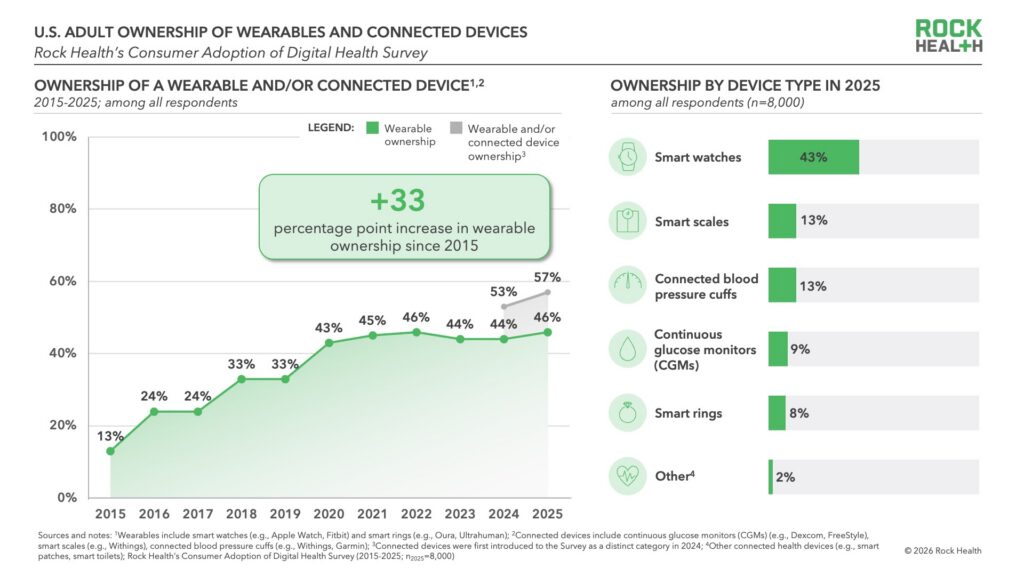
According to our Survey, 57% of U.S. adults report owning at least one wearable2 or connected device.3 Forty-six percent report owning a wearable specifically, representing a 33 percentage point climb from 13% in 2015.4 In recent years, wearable adoption growth has plateaued, with first-time user capture slowing.
Smart watches still lead the form factor mix, with roughly 4 in 10 respondents owning a smart watch. Increasingly, consumers are building out their personal tech ecosystems beyond single devices, with average ownership falling between one and two devices per user (1.5). Among the 22% of device owners with two devices, the most common pairings include watches with smart scales, blood pressure cuffs, and smart rings.
Few domains of digital health have pulled off the engagement and retention numbers that wearables have. Eighty-three percent of wearable owners wear their devices five or more days per week, including 59% who wear theirs always or nearly always (e.g., except when charging). Oura recently reported that its rings see a remarkable 23.8 hours of daily wear time, on average. Long gone are the days of workout-only accessories (though an Apple Watch at weddings remains a hotly contested faux pas). Most wearable owners use their devices to track physical activity (35%), sleep (26%), and heart rate (21%).
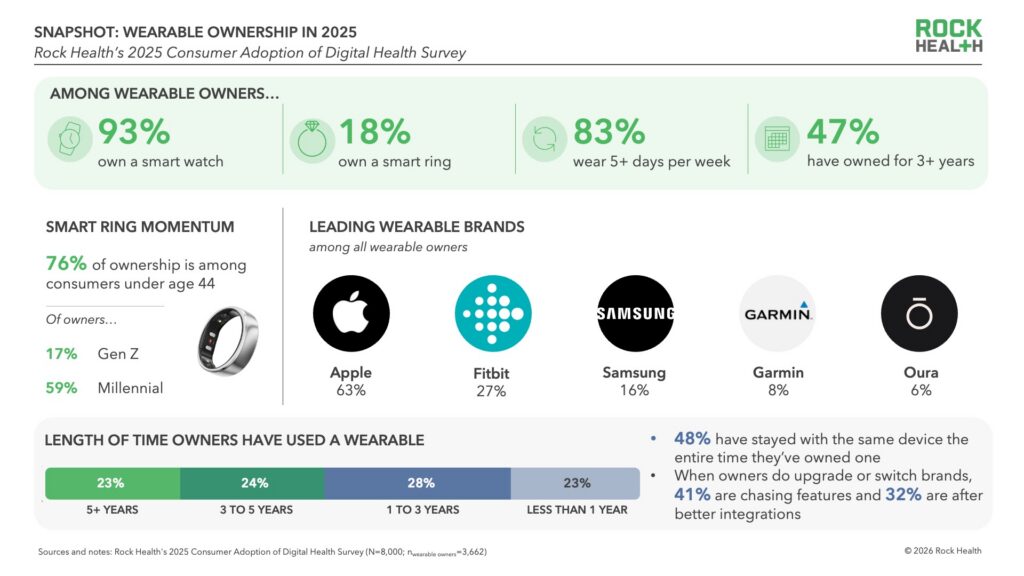
Nearly half of wearable owners (47%) have used a wearable for three or more years. Once consumers pick a brand ecosystem, they tend to stick with it: 48% are still using the same wearable they started with, while 27% have upgraded to a newer model from the same brand. When consumers do upgrade or switch brands, they most commonly report chasing new features and better device/app integrations. Just 23% have switched brands altogether. Part of that stickiness comes down to convenience and brand identity. Oura’s “Give Us the Finger” campaign reflects how wearables are increasingly marketed through lifestyle positioning as much as technical capability—svelte enough to look like jewelry, recognizable enough to operate like a status symbol among peer-groups. Accumulated data matters, too. Over time, wearable loyalty reinforces itself—switching platforms can mean abandoning years of longitudinal data, especially when metrics don’t map cleanly 1:1.
Want a closer look? The slides highlighted in this piece are available for download—plus an exclusive cut not published in this analysis on how wearable and connected device ownership breaks down across demographics.
Who’s wearing and who’s connecting
Adoption still clusters around a fairly specific (and familiar) user profile. Compared to non-owners, device owners are generally younger, wealthier, more urban, healthier, and more likely to be commercially insured—trends we’ve seen reflected in our prior research. Women own wearables and/or connected devices (58%) at similar rates to men (57%), and device ownership is higher among racial and ethnic minorities (64%) compared to 54% of white respondents.
We see more granular variation at the device level—some highlights:
- Smart rings, for example, have gained traction particularly quickly among younger consumers, with Millennials accounting for 59% of owners
- Smart watches are the only device that skews toward women (53% of owners), while men over-index on everything else—continuous glucose monitors (CGMs) (56%), smart rings (54%), connected blood pressure cuffs (54%), and smart scales (52%)
Health status introduces another familiar tension. Device owners are more likely to describe their health as “excellent” (23%), while non-owners are more likely to report moderate, poor, or very poor health. The paradox: populations that could potentially benefit most from passive monitoring and longitudinal tracking often remain the least likely to own these devices. Part of that dynamic reflects where this tech has gained traction commercially. Across all device types, self-purchase is the reigning acquisition channel, and the category’s positioning reinforces who it reaches—Oura toward restoration and balance, Garmin and Whoop toward strain and performance—the underlying pitch is oriented toward optimization for people who are already well. The unserved opportunity runs in a different direction: consumers who aren’t optimizing but trying to manage to their own baseline amidst illness. But whether wearables can extend beyond the relatively healthy and affluent may depend on regulatory support and price accessibility, more than feature roadmaps.
The consumer-clinical confluence
As wearable adoption grows, the data generated by these devices increasingly accompanies consumers into the traditional healthcare system. Fifty-nine percent of wearable owners have already discussed their wearable data with a healthcare provider: 30% do so regularly, while 29% have done so at least once. Another 20% said they want to discuss their wearable data with their clinician but haven’t yet. The appeal is fairly straightforward, given wearables capture something traditional healthcare visits can’t: a continuous and often long-term picture of how people function between appointments.
But by and large, clinical infrastructure has yet to loop this data in. Experts tell us many health systems haven’t turned on Apple HealthKit or Google Health integrations within their patient portals. The liability question alone—what happens if a clinician misses a flagged fall or AFib alert?—has been enough to keep many traditional providers on the sideline. The lack of a clear reimbursement pathway for asynchronous data review hasn’t helped. Workflow integration is making progress, but the lag is still there.
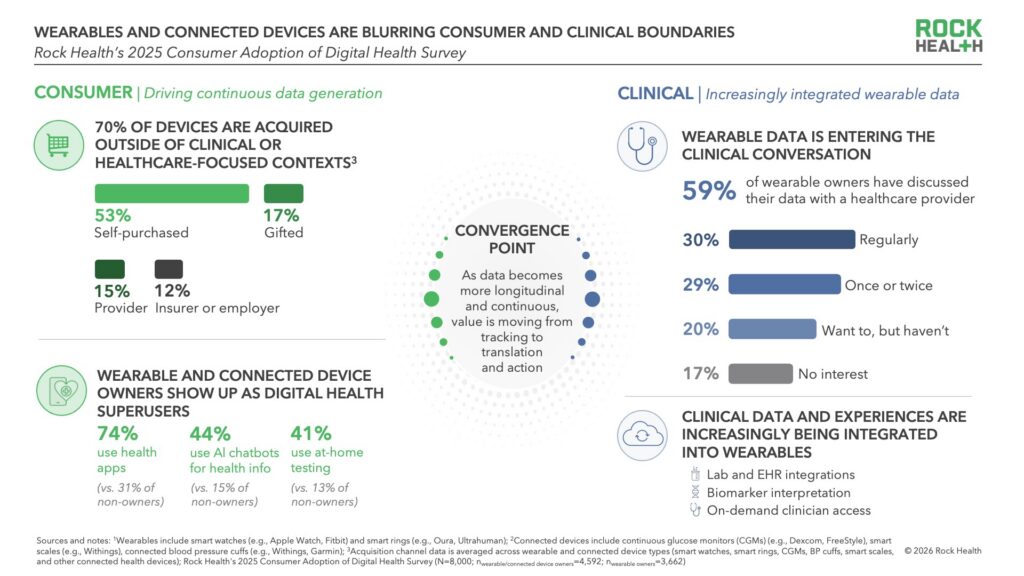
The brittleness of the traditional care delivery system hasn’t stopped consumer wearable companies from increasingly expanding their offerings and services into clinical insights—and ultimately, the care delivery domain. Major makers are experimenting with bloodwork integrations that translate biometric signals insights and follow-up recommendations. Apple and Samsung have pursued FDA clearances for clinical features, and Oura and Whoop users can now connect directly with on-demand clinicians who have access to a full set of biometric data, lab results, and medical history.
“There’s a rising tide of wearable data, and the major AI platforms are only going to get smarter with it. If providers and EHRs don’t figure out how to absorb that and make sense of it, they’re going to be operating at a longer-term disadvantage.”
— Mike McSherry, Co-founder & CEO, Xealth (a Samsung company)
Meanwhile, traditionally clinical devices, like CGMs, are going over-the-counter, repositioning themselves for consumer and wellness audiences. Dexcom Stelo and Abbott Lingo are marketed to metabolically curious consumers, with Serena Williams partnering with Lingo to promote the benefits of non-diabetic blood sugar monitoring. While 53% of CGM owners report a diabetes diagnosis,5 the remaining share (47%) reflects adoption beyond traditional condition management. CGMs’ consumer crossover, in particular, unfolded in phases: in the early 2020s, platform players like Levels, Nutrisense, and January AI offered devices from incumbent CGM manufacturers to deliver metabolic insights; and now, CGM manufacturers themselves are building consumer-facing experiences rather than relying on intermediaries. The dynamic has been relatively unique to CGMs given their origin story as a medical device—other types of device makers have generally kept their hardware and consumer experience tightly intertwined, leaving less room for standalone consumer platform plays.
Across the category, the distinction between “consumer” and “clinical” wearables is starting to soften. Consumer devices are layering in clinical services, while clinical devices are increasingly being repackaged for everyday life.
No more mixed signals
As consumers generate more continuous health data, the question about what to do with it gets bigger and bigger:
For wearable companies and digital health builders
Wearable companies are facing a new era of heightened competition and rapid experimentation. A long string of new AI and platform integration partnerships reflects a market that is prioritizing data sharing and interoperability in service of a more continuous, context-aware picture of one’s health—but a fully integrated experience may have psychological limits as well as technical ones. Will people trust wearable platforms enough to share their most sensitive health data? Is there a point at which a “connected” experience starts to feel too connected, or even intrusive? Some health data feels deeply personal, and constant scoring can induce anxiety (or false reassurance) just as much as insight. For companies building in this space, it’s worth acknowledging that the more comprehensive the self-health portrait these platforms create, the more it may start to feel like surveillance—and managing that tension will be as important as the technology itself.
Meanwhile, innovators are still experimenting with what wearables look like, along with how they’re priced. Next-generation form factors—earrings, earbuds, and waistbeads—are launching around specific conditions, lifestyles, and consumer identities. Smart glasses are back in testing rotation; new sensor research and novel launches, like Clair Health’s hormone monitoring wristable, are joining the rotation; GLP-1 companion features are being added by companies like Oura and Dexcom Stelo-partnered Signos. Google’s screenless Fitbit Air hit shelves at $99.99 without a required subscription (a strategy we’ve seen other players compete on in their categories). We don’t expect the market craze to slow down any time soon. Oura’s exit (and Whoop’s, too) will mark the category’s first public-market test since Fitbit. By then, investors will be evaluating a market that’s swirling around part consumer product, part health infrastructure layer, part identity signal—still very much in the middle of figuring out what consumers actually want wearables to do and become.
“Sensors in existing devices haven’t really evolved over the past five to ten years. Most still use the same set: photoplethysmography (PPG), temperature, maybe an accelerometer or gyroscope. If there are no novel sensor types, the data you can collect doesn’t change either, and the algorithms are lacking the broader picture that new sensors could enable. Most wearables, for example, filter female physiology data out as noise. The cycle is technically a fifth vital sign, and yet no consumer device to date has been able to continuously track hormonal data.”
— Jenny Duan, Co-Founder & CEO, Clair Health
For health systems
Wearable companies are now far from just device manufacturers—they’ve started connecting into, and in some cases even creating care delivery ecosystems, building out in-app provider access and specialty care partnerships. On the forecast: a disintermediation risk in which new access points disrupt typical patient flows and referrals through health systems. A consumer whose device flags irregular sleep respiration patterns and routes them in-app to a specialist may never loop in their traditional PCP. As these ecosystems mature, health systems will need to determine where partnerships can create bridges (rather than disintermediation) between device manufacturers and clinical care, while also determining where integrating wearable data into care delivery actually improves outcomes. For the latter, smarter bets are in populations where continuous, between-visit monitoring can change clinical decision-making, like for patients managing active oncology treatment or heart failure. Health systems that don’t find a way to engage with this data—and plug into the clinical ecosystems being built around wearables—risk being sidelined.
“We’re seeing a bifurcation in how physicians are thinking about wearable data. Forward-leaning primary care and longevity-focused clinics, mostly private pay, are all in. They’re pairing wearable streams with lab work and using the combination to fine-tune care in ways that weren’t possible before. On the other hand, the reality for large health systems serving general populations—their day-to-day—is different. They’re working to keep patients engaged in basic chronic care management. The opportunity for wearable data is enormous there, but the starting point is worlds apart.”
—Drew Schiller, Co-founder & CEO, Validic
For public health
The next chapter of wearable adoption will come down to whether wearables remain primarily tools for individualized self-optimization—an “N of 1” model—or evolve into infrastructure that improves population health. The populations whose inclusion would most strengthen population-level insights have the most reason to distrust passive, continuous monitoring—meaning the algorithms built on wearable data will continue to reflect and reinforce who the technology has historically served. Getting to the future will depend less on generating more data and more on expanding adoption across underrepresented populations, demonstrating everyday utility beyond self-quantifiers, and earning trust on how data is collected and used.
What tracks
The question about wearables a decade ago was whether consumers would adopt wearables, and indeed, they have. What remains unresolved is impact—in what these devices can generate and what can be done with this data to meaningfully improve health outcomes.
Dig deeper into the data behind this piece—including how wearable and connected device ownership varies across demographic dimensions, where the opportunities are for consumer-clinical integration, and strategic implications for the organizations building in or around this category—with Rock Health Advisory. Reach out to learn more.
Get in touch with the venture team at Rock Health Capital.
Join us in building a more equitable future at RockHealth.org.
And last but not least, stay plugged into the Rock Health community and all things digital health with the Rock Weekly.
Footnotes
- Survey respondents (N=8,000) are Census-matched by gender, age, U.S. region, race/ethnicity, and annual household income. The Survey was administered from December 1, 2025 to December 23, 2025. Respondents used their personal desktop, laptop, smartphone, or tablet to complete the Survey in English.
- Wearables include smart watches (e.g., Apple Watch, Fitbit) and smart rings (e.g., Oura, Ultrahuman).
- Connected devices include continuous glucose monitors (CGMs) (e.g., Dexcom, FreeStyle), smart scales (e.g., Withings), connected blood pressure cuffs (e.g., Withings, Garmin), and other connected health devices (e.g., smart patches, smart toilets).
- Beginning in 2024, the Survey expanded beyond wearable devices to also include connected health devices such as CGMs, connected blood pressure cuffs, and smart scales. Results from prior years reflect wearable ownership only.
- Including Type 1 diabetes and/or Type 2 diabetes.