

Healthcare innovation at the turn of 2026: Mapping what’s now and what’s next in digital health
As 2025 winds down, healthcare leaders are taking stock of the year’s defining shifts—and looking to where momentum is building for 2026. Over the past two years, we’ve used the Rock Health Innovation Maturity Curve to provide our take, grounded in data. Our goal isn’t to characterize the entire digital health market, but to track how key measures of research, capital, and commercial activity together reveal important clues about where innovation is gaining steam, where it’s stalling, and areas that are beginning to show early signs of scale.
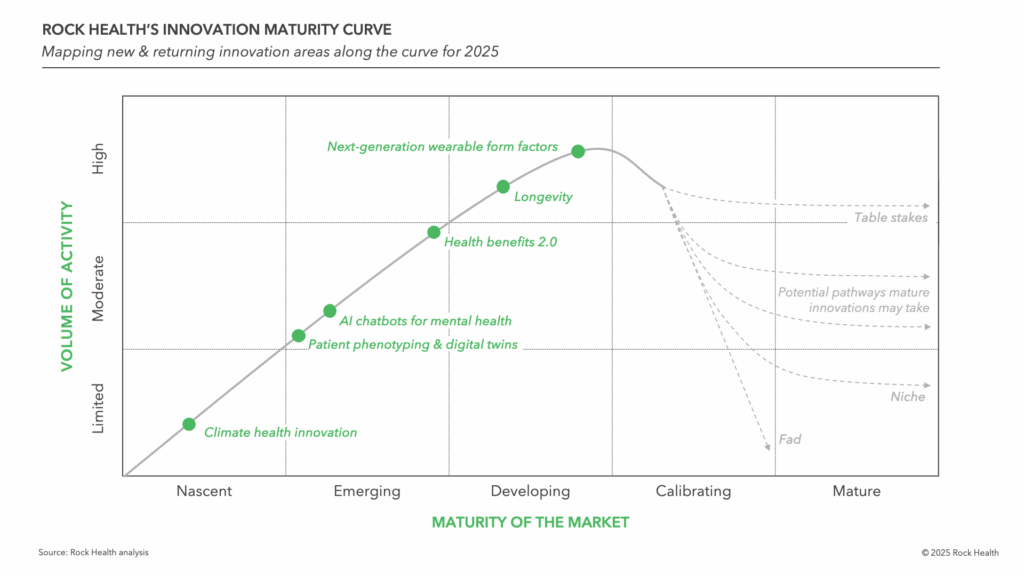
This year, we offer an update to three of last year’s innovation focus areas—next-generation wearable form factors, patient phenotyping and digital twins, and climate health innovation—and add three that have been commanding significant attention in 2025: longevity, AI chatbots for mental health, and “health benefits 2.0” (what we’re calling the latest wave of alternative benefits solutions).
Taken together, these six areas offer a clear view of where attention and resources concentrated this year—and help us focus on key signals to watch heading into 2026.
The Rock Health Innovation Maturity Curve
Instead of relying on intuition or short-term buzz, the Rock Health Innovation Maturity Curve (“Innovation Curve”) draws on consistent, quantifiable signals of attention and traction to convey the relative maturity of different digital health innovation areas.
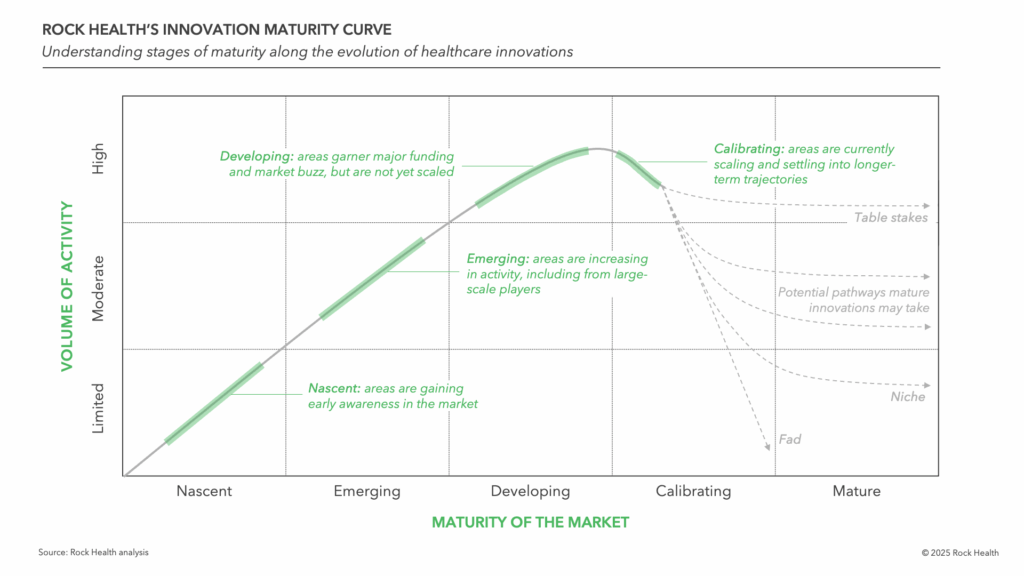
Our analysis tracks activity across three dimensions:
- Research activity: Gauges the scientific and early-market potential of a topic via PubMed publication activity. High research volume signals nascent exploration, while plateaus suggest more established trends
- Venture funding activity: Tracks investor interest using funding totals from the Rock Health Digital Health Venture Funding Database. Investment activity is a leading indicator of commercial interest and level of maturity
- Partnership activity: Uses industry partnerships from the Rock Health Digital Health Partnership Database as a proxy for commercial traction. High partnership volume and growing momentum point to an innovation area moving from pilot phase to scaled impact
For each innovation area, we assess both the level of activity year-to-date in 20251 and how that activity has shifted over the past two years. A weighted combination of those measures places each area of activity along the Innovation Curve—from nascent to mature—based on its current traction and momentum.
How last year’s innovation areas fared in 2025

Patient phenotyping and digital twins
Nascent (2024) → Emerging (2025)
Phenotyping (classifying patients by key biological, behavioral, or genetic attributes) and digital twins (virtual models of patients or systems) advanced this year as these AI-enabled simulations began surfacing insights that standard analytics couldn’t. Research volume surged in oncology and metabolic/endocrine conditions—areas where testing treatment adjustments digitally can reduce costly trial-and-error. However, hype could drive definitional creep: if the “twins” label is liberally applied to more basic models, buyers may be underwhelmed and write off the entire category, even models with stronger potential. The commercial landscape reflected these growing pains. Twin Health raised $53M at nearly a $1B valuation in Q3—but funding otherwise slowed to just 0.5% of all digital health investment1 (down from 2.4% last year), with few new enterprise partnerships.
What comes next: Three dynamics will likely shape the pace of adoption across the industry. The first is data governance: as digital twin technology becomes more accessible, questions around privacy, patient consent, and the provenance of AI-generated predictions will become more critical. The second is regulatory clarity. Federal agencies are open to engaging with simulation-based evidence, but without clear standards and benchmarks, it’s unclear how quickly they’ll be accepted in clinical practices. Third is reliability: clinical leaders will want to see whether a model stays stable as new inputs arrive, and whether it can call out when it’s no longer confident.
Next-generation wearable form factors
Emerging (2024) → Developing (2025)
While the range of form factors continues to grow, we saw movement from novelty to real adoption this year. Rings led a lot of the heavy lifting: Oura’s $900M raise at a nearly $11B valuation became the largest digital health deal on record since we began tracking funding in 2011, as the company sold more rings in just over a single year than the prior 11 years combined. Apple’s AirPods picked up heart rate monitoring, and Lumia released earrings that capture blood-flow patterns. Research output also rose this year, with studies focused on metrics once considered too tricky to track continuously (like multi-site cardiovascular indicators).
What comes next: The next phase will be determined, in part, by how companies navigate the increasingly blurry line between consumer tools and diagnostics. Following Whoop‘s slap on the wrist, camps are forming: some are investing in formal approvals, others toeing the line (Apple’s hypertension “warnings”), and some are sticking with wellness. The newcomers—companies advancing ear- and patch-based sensors, for example—will need to decide whether to push towards formal FDA approvals or operate at the edge of consumer wellness. Growing federal focus (and models to pay for wearables) for preventive health and chronic conditions will likely inform how much—and how quickly—these tools will integrate into the “formal” healthcare system.
Climate health innovation
Nascent (2024) → Nascent (2025)
Across 2025, climate health innovation remained stalled in nascency, even as the case for action grew harder to ignore. Researchers published new work tying rising U.S. temperatures to an uptick in heat-related deaths, while global health organizations like the WHO introduced guidance to support the integration of climate and health data. However, we didn’t see new investments or more than a couple of enterprise partnerships in climate health this year, and the U.S. policy landscape—marked by sweeping environmental regulatory rollbacks—offered little momentum. Despite investor excitement to integrate climate data into population health, most climate health venture activity this year came from outside the U.S.
What comes next: For corporations, startups, and investors to take a deeper plunge into climate innovation, they’ll need to see business cases built around the outcomes of climate-driven health events, rather than abstract environmental monitoring. Health systems and payers may focus initially on targeted interventions: for instance, automated outreach when air-quality indexes spike for high-risk asthma patients or expanded drone delivery in flood-prone areas.
The innovations that defined 2025
Alongside the aforementioned returning areas, we mapped a set of new topics that emerged as priorities this year.
Longevity
Developing
Longevity entered the Innovation Curve this year as companies pushed beyond the one-off diagnostics model to see whether personalized baselines can anchor ongoing care. Function Health’s $298M raise (and staggering $2.5B valuation) crystallized the appeal of broad, consumer-facing diagnostics. Midi’s AgeWell launch reframed aging as part of routine women’s midlife health—bringing metabolic and hormonal evaluation into an insurance-covered model rather than a one-off, cash-pay experience. And Hone Health expanded its metabolic model with in-home services to support longevity-focused care. Each program is trying to see if episodic testing and engagement can motivate long-term behaviors impacting slow physiological changes—and if they can avoid the crash that some similarly-oriented startups have seen.
What comes next: The diagnostic land grab has already happened; the superpower of Superpower (among others) is the ability to collate a staggering amount of biological information. What hasn’t been solved is the translation layer: how much will insights related to hormonal variance or cardiovascular strain become concrete adjustments that consumers (or their providers) actually act on? The competition ahead will hinge on turning long-arc patterns into timely guidance that feels both credible and valuable. If a few teams can deliver, longevity may start to function less as an optional add-on and more as a core part of how preventive care is delivered.
AI chatbots for mental health
Emerging
We included “AI in healthcare” on last year’s Innovation Curve, but this year, with AI just about everywhere, we zoomed in on one application in particular. AI chatbots used for mental health were a flashpoint. While some pre-scripted AI chatbot companies shut down, citing regulatory challenges or ethical concerns, many companies doubled down. Slingshot’s debut, backed by a headline-grabbing $93M raise, signaled investor conviction in purpose-built mental health AI chatbots. Existing players like Talkspace and Lyra launched their own plans for conversational chatbots trained on therapy conversations, while Spring Health even announced a bot to evaluate the safety of other therapy bots. In contrast, a wave of stories about people turning to general purpose AI chatbots for emotional support—sometimes with dangerous results—reinforced the challenges of consumers seeking help against the backdrop of the severe mental health access crisis (with long wait times, thin provider networks, and inconsistent follow-ups in traditional care).
What comes next: Regulatory attention is intensifying as lawsuits involving general purpose chatbots and state AI therapy bans draw the FDA into questions about where conversational chatbots fit within mental health care, and how safe they are. Some players are considering narrowing the scope of what these tools attempt, looking to frameworks like VERA-MH to show that their systems behave consistently and hand off when they should. Others may find more success in lower-risk territory—tools that handle the routine work around therapy, or keep patients engaged between visits.
Health benefits 2.02
Emerging
2025 brought noticeable shakeups in the benefits landscape, from cuts to public coverage programs like Medicaid, to rising commercial and ACA premiums. Out-of-pocket spending continued to climb, while employers faced the steepest benefit cost increase in 15 years. Those pressures opened space for non-traditional benefit models to gain further traction. ICHRAs (Individual Coverage Health Reimbursement Arrangements, which allow employers to determine a fixed contribution for employees to buy health insurance and services) and the startups that support them had a stand-out year—with companies like Thatch and Venteur landing $40M and $20M, respectively. Pharma’s direct-to-patient programs expanded to bring lower-friction access into employer channels. In pharmacy, competition widened around traditional PBMs, as alternative PBMs and cash pricing solutions captured contract wins and funding dollars.
What comes next: This rising pressure isn’t expected to let up any time soon, and with plenty of federal signals of support, we expect to see this category grow in 2026. For many people, using traditional insurance already feels complicated; with more costs moving toward consumers, the benefits experience may start to look even more like a set of adjacent marketplaces rather than a single plan. We’ll be keeping an eye out for growth in alternative health plans and solutions that help both employers and consumers compare options with clear pricing in fewer steps.
Chasing the curve
Digital health innovation in 2025 looked markedly different than last year. Advancements in AI compressed how quickly categories could advance their capabilities. The new federal administration shaped the field just as forcefully, opening lanes in some places and tightening them in others, often with little warning. Digital health enters 2026 with those same dynamics to contend with—enabling the potential for both faster lift and sharper drops.
Healthcare’s innovation curve is always evolving, shaped by new technologies and shifting priorities. As we track these trends into 2026, we’re eager to hear from you: What themes are you hearing about or exploring—and how can we help you and your organization translate these trends into smart innovation bets? Reach out to Rock Health Advisory for support or submit your ideas to inspire our future deep dives!
Tap into insights and strategic guidance for enterprise companies with Rock Health Advisory.
Get in touch with the venture team at Rock Health Capital.
Join us in building a more equitable future at RockHealth.org.
And last but not least, stay plugged into the Rock Health community and all things digital health with the Rock Weekly.
Footnotes
- Year-to-date 2025 includes data between January 1 and October 31, 2025.
- Because formal academic publications on “Health benefits 2.0” are scarce, research activity for this topic was measured using relative Google keyword search frequency, rather than PubMed publication volume