



Q3 2026 market update: Crystallizing fifteen years of digital health
In 2011, the digital health sector was in its early innings. Health systems and startups weren’t often found in the same rooms together, and the idea that patients would access care through consumer technology was a distant bet. Rock Health launched early that year with a simple conviction: technology could make healthcare better. Fifteen years later, the sector has collectively raised over $140B, nearly half of American adults own a wearable, and advancements in technology have opened new opportunities for more accessible, personalized care at scale.
Across the years, policy shifts have unlocked new paths for commercial success, and reimbursement codes created more reliable routes to recurring revenue. Some developments, like the COVID-19 pandemic, opened up possibilities once out of reach, even in the face of great limitations. And yet for all that’s changed, many of digital health’s earliest ambitions remain unfinished.
On the week of the 15th annual Rock Health Summit, we’re celebrating by reflecting on the progress—and vast remaining potential—of healthcare technology.
A 15-year anniversary is considered the crystal anniversary, symbolizing clarity, transparency, and strength of a mature relationship. An apt theme for this piece, which seeks to find clarity from experience, and turn the lessons learned of the past 15 years into fuel that powers the advancements that come next. To help us crystallize our thinking (see what we did there!), we asked a few of our friends—longtime builders, investors, and thinkers—who have helped mold this sector to reflect with us (we fondly refer to this group as the “OGs” throughout). We asked each: how their definition of digital health has evolved since the beginning, which moments most changed the sector’s trajectory, and what they see coming next. Throughout this piece, we pair their perspectives with our own.
But before we turn the pages back too far—here’s what happened in Q3 this year: U.S.-based digital health startups raised $3.7B in capital across 114 deals in Q3 2026, bringing 2026’s year-to-date total to $11.1B across 358 deals. Capital continues to concentrate in bigger checks and fewer deals—2026’s year-to-date average deal size climbed to $31.0M, up from $29.5M in 2025 and $20.6M in 2024.
The exit market has kept pace with 2025, a high watermark since 2021. Q3 2026 logged 45 digital health M&A deals, bringing 2026’s year-to-date total to 164, on par with 2025 (172 through Q3). The public markets have stayed quiet with no new listings (though news of a postponed one) since HeartFlow in August 2025. All in all, Q3 continued much of what we’ve been watching across the year’s earlier quarters: plenty of capital (much of it concentrated), steady M&A, and hints of public market debuts to-come. Now, a look back at what it’s taken to get here.

All the way back to 2011
The early days of health information technology bring to mind massive server rooms in hospitals, bulky machines, and limited computing power. While there were signs of a budding digital health market, it had yet to materialize. Health tech-focused entrepreneurs, investors, and buyers were relatively scarce. But there was a group of early believers. One of these believers was Sean Duffy, Co-Founder and CEO of Omada Health,1 just getting his now-public company off the ground (in part at Rock Health’s original SF Chinatown office!). Duffy remembers noticing “less convergence” between healthcare and technology at the time, with few accelerators and talent oriented around the category. Halle Tecco, Rock Health founder, investor, and author of Massively Better Healthcare, remembers having to make the case that technology entrepreneurs could even have a role in healthcare. We saw our early purpose as helping to catalyze the digital health sector—that meant literally defining it, delivering consistent data-driven analysis, and bringing together like-minded builders, investors, and buyers. A look back at our inaugural 2011 “Rock Report,”2 which launched our sustained coverage of this new venture category, reveals just how nascent the market was. At the time of its release in August 2011, we counted just 35 U.S.-based venture-backed digital health companies so far that year.3
Michael Greeley, Co-Founder and General Partner of Flare Capital Partners, described early investment activity as the “Wild West.” The digital health market was caught between healthcare funds trying to figure out technology, and technology funds trying to figure out healthcare. Founders would find themselves needing to explain and defend the digital health category before they could make the case for their own company. Only 2% of surveyed early-stage digital health entrepreneurs in 2011 reported securing VC funding, compared to 84% that were bootstrapped. Funding was the most frequently cited barrier for growth (we had a few ideas on how to chip away at that gap; Rock Health launched our own early-stage digital health fund). The good news? Optimism was fierce. Seventy-seven percent of VCs in a 2010 survey reported an expectation that “healthcare IT investment dollars [would] increase.” To put that prediction in perspective: 2011 overall saw $1.2B in venture dollars invested across 96 deals.4 If 2026’s pace holds, this year’s funding could surpass $14.8B5—roughly 12x the total 15 years ago. Today, more than 3,200 venture-backed digital health companies have raised $2M or more.
A healthy startup ecosystem is one ingredient for a functioning innovation market—another is the buy-side’s interest in and ability to adopt new solutions. In many respects, healthcare incumbents have been key to impact at scale. Fifteen years ago, healthcare incumbents were predominantly skeptics and dabblers when it came to the application of new technologies within their organizations. We saw firsthand that the sector needed greater understanding and connectivity to bridge the startup and enterprise sides of the market—and that belief ultimately led to the launch of our advisory work.
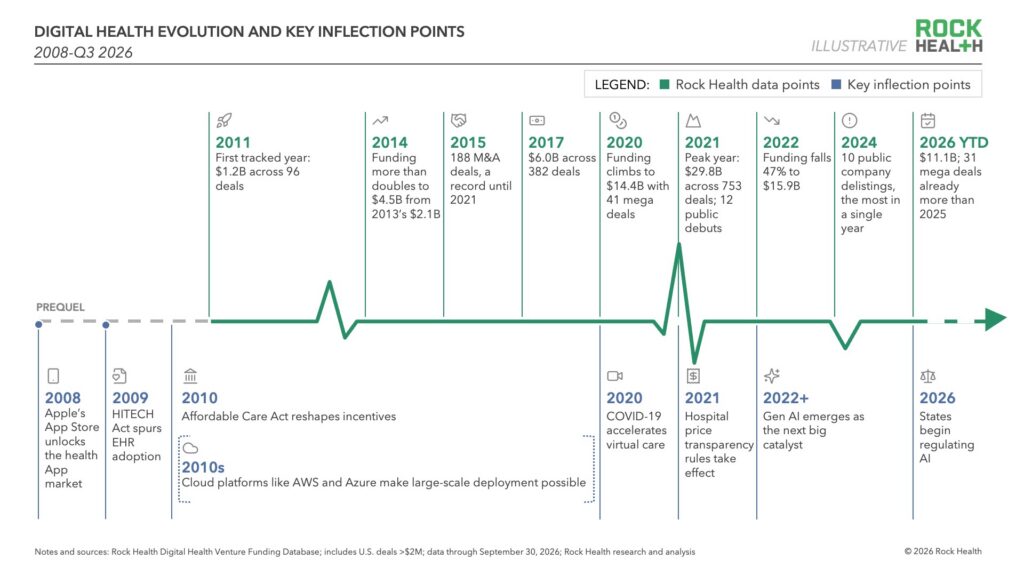
Now, after a decade-plus of digital health investments, 200+ healthcare enterprise partnerships, (nearly) 15 Rock Health Summits, hundreds of market intelligence reports, and too many Rock Weeklys to count, we’re sharing some of the reflections that have defined the digital health market’s journey.
Innovators have pushed past digitization for digitization’s sake
Early digital health innovators had no shortage of enthusiasm for digitization itself. Chris O’Dell, President of Turquoise, remembers when the hottest health system buzzwords were things like “e-visits” and the “digital front door.” Much of that first wave of innovation started with healthcare as it was, and put it on a screen. Nickolas Mark, Co-Founder and Managing Partner of Intermountain Ventures, the venture arm of Intermountain Health, described early efforts as “digitizing forms, and not the workflows around them.”
O’Dell recalls the misses of automating parts of the healthcare experience people valued most, including the physician-patient relationship. But he has watched the sector become more discerning about what should—and shouldn’t—be made digital.
Over time, we’ve (largely) shifted away from automating away the clinician relationship, and toward automating administrative waste. To borrow a phrase from Mark, the sector is moving toward “addition by subtraction”—digitization that removes unnecessary steps and cognitive load. Take electronic prior authorization, which has replaced phone calls and faxes (though not entirely!), or ambient documentation, which has made it easier for clinicians to capture visit notes in real-time, or decentralized clinical trials, which spare participants the trial site to-and-from for every check-in or blood draw. Some of digital health’s clearest wins have come from taking burdens off of users. Of course, not all ambitions can be realized by taking something away; there are still deep-rooted problems to solve for, and plenty of experiences worth reimagining from the ground up. But years of experimentation have given the sector a more nuanced sense of what useful innovation looks like—and made digitization itself a less convincing measure of progress.
The bar for building (and buying) has risen
In some ways, building a digital health company is much easier than it was 15 years ago. Tecco recounts when founders had little choice but to build an extraordinary amount of the tech themselves. Since, “every generation of healthcare founders gets to start a few floors higher. You can plug into APIs and third-party services for insurance verification, claims processing, EHR infrastructure, virtual clinician networks, payments, prescribing, and so much more. Things that once took years and millions of dollars to build can sometimes be assembled in months.” And not just assembled, but ready-to-ship—generative AI and computing power have made building more accessible. This means new entrants are fast-following established products with AI-native tech stacks they can build with greater functionality and at lower cost.
Easier building is just one of many factors that has contributed to today’s crowded, competitive technology environment. John Brownstein, Chief Innovation Officer and Senior Vice President of Boston Children’s Hospital, conveyed the complexity health systems are navigating as buyers; they’re fielding more pitches from new entrants while navigating relationships with existing vendors expanding onto one another’s turf. The era of endless pilots has worn thin. As healthcare organizations took turns accumulating point solutions—an understandable strategy for targeted, though incremental change—they’ve learned that buying them one at a time often doesn’t amount to a coherent technology strategy.
Today, organizations are entering a new phase of innovation, taking a more holistic view of technology, people, and process, and consolidating vendors to simplify and integrate their stacks. Daryl Tol, President and CEO of Health Assurance Transformation Company (HATCo), notes, “We see health system leaders that have decided the transformation of the organization is a life-or-death issue, and it has to be driven by the C-suite. This is not about listening to 100 technology companies pitch. This is about architecture, design, and implementation.” He’s curious to see if, with the use of open-weight models and desire for integrated tech, buyers will increasingly build more tech on their own, pushing vendors to compete with each other and their prospective customers. With the competitive stakes climbing, vendors are building new moats of the future. Some OGs noted a willingness to own liability (of growing importance as AI takes on more autonomous roles) as one potential moat. Lisa Suennen, Managing Partner at American Heart Association Ventures, sums up the characteristics that are harder to replicate in an easy-to-build environment: how well a company implements, integrates, or executes—what she describes as the ability to compete on more “deployable value.” With “can it be built?” no longer setting (many) limits of innovation, the questions ahead require greater discernment around usability, integration, and evidence.
There’s more capital and sophisticated investors—but still an unresolved exit environment
Since 2020, U.S.-based digital health companies have been raising at a clip of $10B+ each year (and at times much more). As Michael Esquivel, Partner at Fenwick & West LLP (and official incorporator of Rock Health way back when!), reminded us, “I think it would’ve been hard to imagine back in 2015 that we’d be looking at the venture funding numbers we’re looking at now.” Observing the digital health funding curve over the years, Greeley remarked on its similarity to the Gartner Hype Cycle—a steady rise into a peak (COVID-19), a subsequent dip, and now, “slow, steady growth.” The steep funding rush of the pandemic transformed check sizes (2021 alone saw 88 $100M+ deals), who was investing (more generalists, PE), and the trajectory of that class of high-valuation companies (still recovering). During that boom and bust cycle, the wins and lessons were hard-earned. Greeley describes today’s investor base as smaller and more experienced, with strategics filling in behind the generalists who left after COVID-19.
“Fifteen years ago, we started investing under a thesis: consumers aren’t patient any longer—the job they want done by healthcare is to be healthy; they don’t want to buy more healthcare. They’d much rather be with friends, go out on the weekend, see a show, than be at a doctor’s office or hospital.”
– Lee Shapiro, Co-Founder and Managing Partner, 7wire Ventures
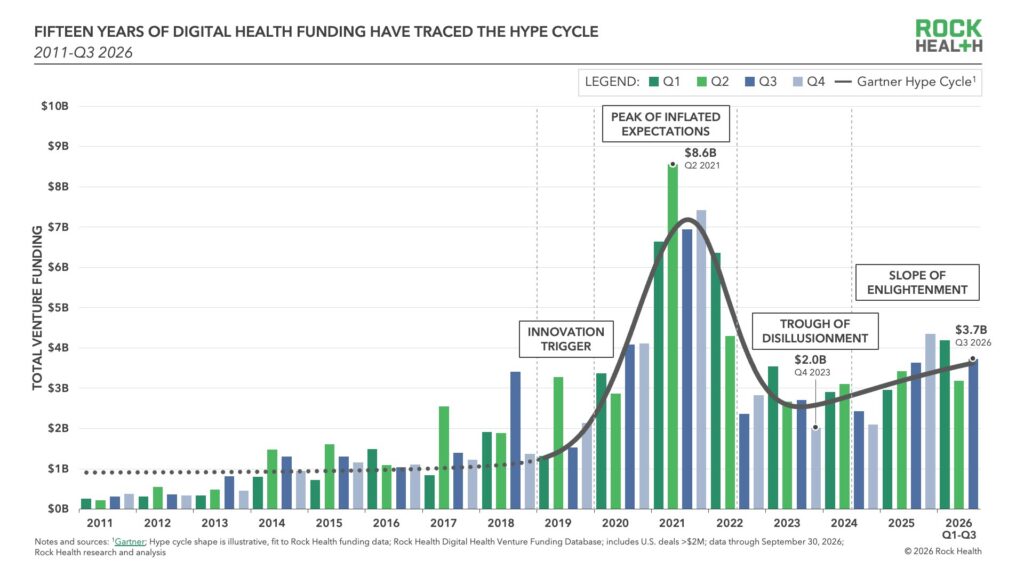
The tenor of those investors tends to be patiently optimistic (it is healthcare after all!). And while there have been exits to celebrate, most companies and investors are still waiting for major liquidity to flow. As Suennen notes, a good idea and a sustainable business don’t necessarily add up to a good investment. With valuations much higher than they were earlier in her career, she now considers the potential for investor returns much earlier when evaluating a company. And for those who do exit, it’s likely via M&A, an exit route that has yielded mixed outcomes for teams and investors. The small portion of digital health companies that have made it to the public markets had to break ground and sometimes struggled to tell a consistent end-to-end story. This dynamic, in some ways, harkens back to the early days of digital health, when part of the work was building a clear rationale (with proof points) to help drive private market investment. Duffy sees public markets as the next opportunity ahead. In his view, the capital markets won’t fully shift until more digital health companies go public, perform well, and hit their earnings marks. The exit environment isn’t going to turn on one or two blockbuster IPOs. It’s going to take strong public-market performances from a succession of companies that restore confidence and clear the runway for those that follow. There is reason to think these exits are coming, even if delayed—investors are still vying for a stake in plenty of early and late–stage deals, expecting to see winners crowned and returns realized. And as Esquivel puts it, innovators need to stay ready to pounce on opportunities: “The strongest companies don’t wait for a window to open. They evaluate the path to liquidity continuously, whether that’s an IPO or an acquisition, and they stay ready to act on whichever one the market and their business support.”
As a venture fund, we’ve seen technology, healthcare economics, and financial markets all change dramatically during our journey—and we’re more excited than ever by the opportunities we see right now.
Don’t count the consumer out
Many of digital health’s earliest solutions were websites and personal health monitoring tools sold to consumers, expanding on consumer behaviors that were already taking shape. Susannah Fox, author of Rebel Health, points out that patients had long been searching outside of the doctor’s office for health information (fueled by the dot-com boom) and connecting online with peers with similar conditions. Mobile technology made this even easier. When Tecco started Rock Health, the widespread use of smartphones was starting to catch on (about one in three Americans owned a smartphone in 2011), the App Store was just taking off, and consumers were beginning to turn to mobile health apps. Rock Health’s first Consumer Adoption of Digital Health Survey found in 2015 that just under one in five (17%) respondents had tracked a health metric in a mobile app and 13% owned a wearable. Fast forward to today, nine in ten Americans own a smartphone, and our 2025 Survey found 57% of respondents have tracked their health digitally and 46% owned a wearable.
Though consumer adoption of digital solutions has grown over time, it hasn’t always given way to durable D2C business models. Consumers as buyers present unique challenges—their demand is notably episodic and contextual, they can be hard to reach and retain, and many are reluctant or unable to pay out-of-pocket. Early builds of health apps faced high attrition and low lifetime value, and selling to the consumer largely fell out of favor. In Rock Health’s 2017 Enterprise Sales Survey, 61% of surveyed companies that had started as D2C had shifted to B2B2C (45%) or B2B (16%) models. “It’s a B2B world,” we concluded back then.
A decade later, it’s not as simple as either/or. D2C is largely back in the mix, alongside even more consumer focus in B2B2C models. Providers, employers, and health plans are still critical channels for reaching patients—but they too are being impacted by an ever more consumer-centric environment, tasked with competing on the reduced-friction experiences common in consumer businesses. As Brownstein sums it up, the “center of gravity is moving to the consumer.” The most fundamental paradigms of healthcare are being challenged in turn. Can a consumer get their care needs met by a bot instead of a human expert? Can they pick their healthcare benefits à la carte or expect to see a price before a bill? For all the sector is building toward, the potential of new innovation can only go as far as the access it extends. Rock Health’s vision is to transform healthcare for all humanity—and digital health’s promise will not be fulfilled with people still left behind. The proliferation of new consumer tools and solutions makes it all the more necessary to pay attention to whose needs aren’t being met, and support the innovators who are designing for all communities.
The next 15+
There is plenty left to build. When we asked the OGs what they’re watching next, their answers ranged from AI for proactive care, physical AI, personalization through digital twins (in areas like oncology), R&D, diagnosis of rare disease, and more. Digital health enters its next chapter with something it didn’t have 15 years ago: 15 years of lessons to build from, with the same abiding optimism that bore the very first fruits of the field when it began.
“My advice to founders is: make sure you’re really clear on the why. Building anything worth building is extremely difficult, and so much of success comes down to grit and not giving up. To pull it off, you need to have a deep sense for the why. I still remember the very first patient interviews when we first met patients in their homes, before we were even incorporated. And still to this day, I think, ‘I’m doing it for you guys.’”
– Sean Duffy, Co-Founder and CEO, Omada Health
Whether an OG or G-only (newcomers welcome!), thank you to all the digital health builders, funders, and shapers that make our community what it is today—with deep gratitude and appreciation to the digital health OGs who shared their wisdom with us:
- John Brownstein, PhD – Chief Innovation Officer and Senior Vice President, Boston Children’s Hospital
- Sean Duffy – Co-Founder & CEO, Omada Health
- Michael Esquivel, JD, Partner, Fenwick & West LLP
- Susannah Fox – Advisor, board member, and author of Rebel Health
- Michael Greeley, MBA, Co-Founder and General Partner, Flare Capital Partners
- Nickolas Mark, MBA – Co-Founder and Managing Partner, Intermountain Ventures, the venture arm of Intermountain Health
- Chris O’Dell – President, Turquoise
- Lee Shapiro, JD – Co-Founder and Managing Partner, 7wire Ventures
- Lisa Suennen – Managing Partner, American Heart Association Ventures
- Halle Tecco, MPH, MBA – Rock Health founder, investor, and author of Massively Better Healthcare
- Daryl Tol, MHA – President and CEO, Health Assurance Transformation Company (HATCo)
Rock Health has supported entrepreneurs and builders working at the intersection of healthcare and technology since 2011. In the earliest days of the sector we know today as digital health, Rock Health was one of the first organizations focused on supporting health tech innovators. Through our signature events, which we operate to this day, we connected innovators with the resources, network, research, and sources of capital they needed. As digital health innovation rapidly accelerated, we expanded the ways in which we support the ecosystem—through industry-leading research, strategy consulting, convening, and investing. Today, with digital health powering the future of healthcare, we’re proud to provide leaders across the healthcare landscape with the trusted guidance they need to succeed.
+ Tap into insights and strategic guidance for enterprise companies with Rock Health Advisory.
+ Get in touch with the venture team at Rock Health Capital.
+ Join us in building a more equitable future at RockHealth.org.
+ And last but not least, stay plugged into the Rock Health community and all things digital health with the Rock Weekly.
Footnotes
- Omada Health is a (now exited!) portfolio company of Rock Health.
- For those keeping close tabs: upon clicking through to the 2011 “Rock Report,” you might note a disclaimer on the page humbly stating, “we’re not professional researchers.” One of the coolest parts about writing this piece has been for us to reflect on just how much Rock Health itself has evolved over the past decade and a half, always in service to the continued advancement of healthcare innovation. Due to the interest generated by our earliest market reports (including the one this footnote is about!), Rock Health DID stand up a dedicated research function that has continued to put out market reports—and much more—ever since.
- Includes companies that have raised $2M or more in venture funding.
- Rock Health continues to update historical years’ data as previously undisclosed deals surface through later announcements. Our current database therefore captures more 2011 activity than we originally reported in 2011.
- Assuming a continued funding pace matching the 2026 quarterly average ($3.7B).