

Three questions to pressure-test healthcare enterprise go-to-market strategy
Growth is putting go-to-market (GTM) back on the agenda across healthcare. Under immense pressure to diversify revenue, organizations are pursuing opportunities that can take them beyond their established commercial playbooks. Companies launching digital products, for example, may find themselves selling to different decision-makers or through a different commercial motion than their core offerings. Prior GTM experience still matters, but more organizations are applying it in unfamiliar territory.
Selling into healthcare enterprises introduces specific considerations into a GTM strategy. A business-to-business (B2B) or business-to-business-to-consumer (B2B2C) model describes the broad commercial structure, but it says relatively little about how a product will actually be purchased. Prior experience and existing customer relationships can give companies a head start on their strategy, but new opportunities may still require different approaches to reaching the market or making the case to customers.
It’s not uncommon to underappreciate GTM complexity, particularly as drafting an initial roadmap has never been faster or cheaper (thanks to AI), and access to experts is easier than ever before. But as anyone who’s brought a product to market can attest, it’s the real world test that challenges the assumptions made: whether you’ve chosen the right market to start with, whether you understand how the buying decision gets made (and who you need buy-in from), and whether customers see enough value to pay for what you’re selling. Put differently, GTM isn’t a decision, but a continuous process. For over a decade, we’ve worked with 100+ organizations—regional health systems, national payers, growth stage startups, Fortune 500 pharma and medical device companies—helping teams evaluate new opportunities and chart a path to market. Across that work, three questions have consistently helped us build and pressure-test enterprise GTM strategies.
Question 1: What is the right market to sequence first?
A product or solution may have relevance across several healthcare markets—but relevance alone does not make each an equally good market to start with. Payers buy differently than provider systems and employers bring another set of considerations. Choosing a first market means looking beyond where a solution could fit to where an organization has a real path in. How pressing is the need? What evidence will the market expect, and is that evidence possible to generate? Existing relationships may make one market more accessible, while a complex sales motion may make another harder to break into. Each of these considerations can turn a long list of possible customers into a more practical starting point.

Teams enter the market with a strong hypothesis about where to start (that’s usually not the issue), but the strength of that hypothesis varies greatly. Before committing significant resources to a GTM motion, teams need to test whether their assumptions hold up with prospective customers. Prospective customer conversations are particularly useful for this validation exercise—well-suited to surface the real-world urgency of an identified need and expose practical hurdles that are harder to spot from the outside (e.g., procurement timelines, past implementation challenges). Of note, the strongest starting market may not always be the one with the largest theoretical opportunity (e.g., total addressable market). A smaller market with clearer need and a more viable path to purchase may be the better place to begin.
Once a team secures early commercial traction, the next decision is when to expand. Before making that call, teams should consider:
- Has the product or solution achieved meaningful scale in the first market?
- Have sales, contracting, and implementation become consistent enough to repeat?
- Does operational capacity exist to support sales and implementation in another market?
The answers to these questions can help reveal the expansion timing sweet spot: launching to the next market too early can divide resources before the first motion is mature and time-tested, but waiting too long can leave otherwise ripe opportunities on the table. A mature first motion can also make the next one easier to build as GTM wisdom compounds. Teams can carry forward a richer understanding of their product or solution’s value, common implementation friction points—and collect evidence generated from real-world use along the way. From there, they need to assess what of the first GTM motion translates to the next market and what needs to be adapted or built-from-scratch (see: customer conversations).
Want to hear directly from enterprise and startup leaders that have lived these GTM questions? Register to attend our upcoming webinar on November 10, 2026.
Question 2: Who sits at the buying table?
Teams often enter a market looking for “the buyer.” Among enterprise customers, there may not be just one. Purchasing decisions often involve several stakeholders with distinct roles in moving a solution forward. The end user needs to see enough value to champion and ultimately adopt the solution. Finance needs confidence that the economics work; IT may need to validate integration and security requirements; procurement needs to confirm that the product and vendor meet organizational standards. Each player holds a different piece of the decision, and support (or resistance) from any one can shape ultimate success. For high-value pain points, enterprises are increasingly grappling with whether to move forward on all-in-one solutions or to configure a combination of point solutions designed for specific use cases.
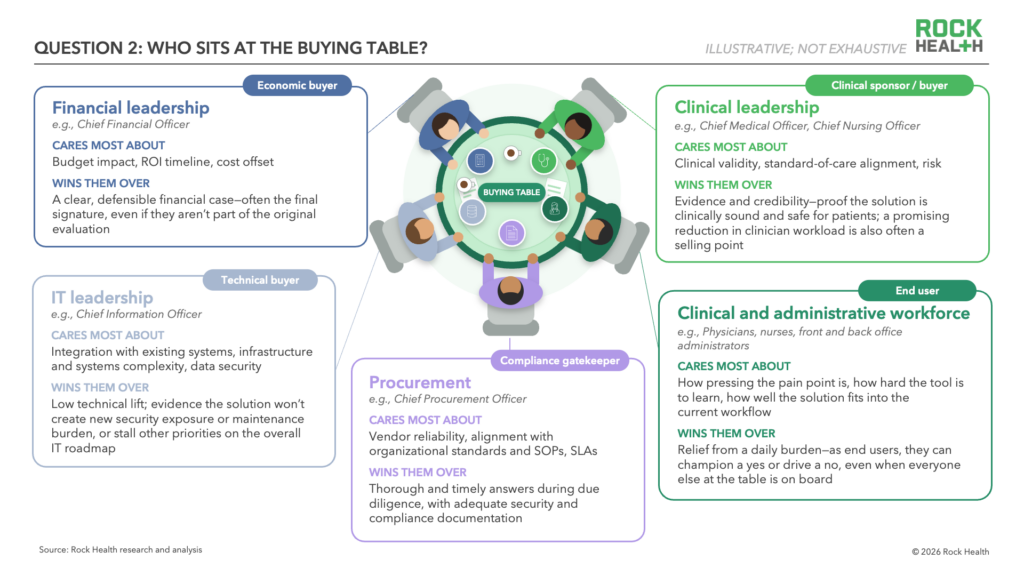
Teams can begin mapping the decision-making structure for a typical customer before a formal sales process begins. Prospective customer conversations are valuable here too, revealing how similar products have been purchased in the past and which stakeholders tend to carry the most influence. Looking to analogous in-market solutions offers another shortcut, allowing teams to borrow lessons from others who have already faced the same market.
On the ground, however, the experience looks different. Influence may sit somewhere unexpected, and the order in which stakeholders need to come on board can shift from one sale to the next. Existing workload, competing priorities, and unexpected budget pressures can all shift where the blocker is, and who needs to be convinced. An internal champion can help teams navigate those dynamics, making the case with colleagues and surfacing concerns that might otherwise arise later. Rather than prescribing a fixed sequence, the stakeholder map gives teams a starting point for understanding how a purchase gets made—and who can help move it forward.
Question 3: Does your value case resonate?
A solution’s value proposition may be clear, but still struggle to translate into a customer’s business case or fit within a pre-planned enterprise-wide build. Improved clinical outcomes or cut costs can sound compelling on paper, but customers evaluate those promises within the context of their own economics and operating model. A buyer working against an annual budget cycle or broader vendor fatigue may struggle to justify an investment that takes three years to generate savings. Another (e.g., a health system) may care about the promised outcome (e.g., improved clinician productivity) but remain unconvinced it can be reliably tied back to the solution being sold.
The sales motion is where those assumptions get pressure-tested. What does the customer need to see to make the case internally? How quickly do they expect to see an impact, and can that expectation be realistically met? Answers to these questions help define the strategy needed to support the sale.
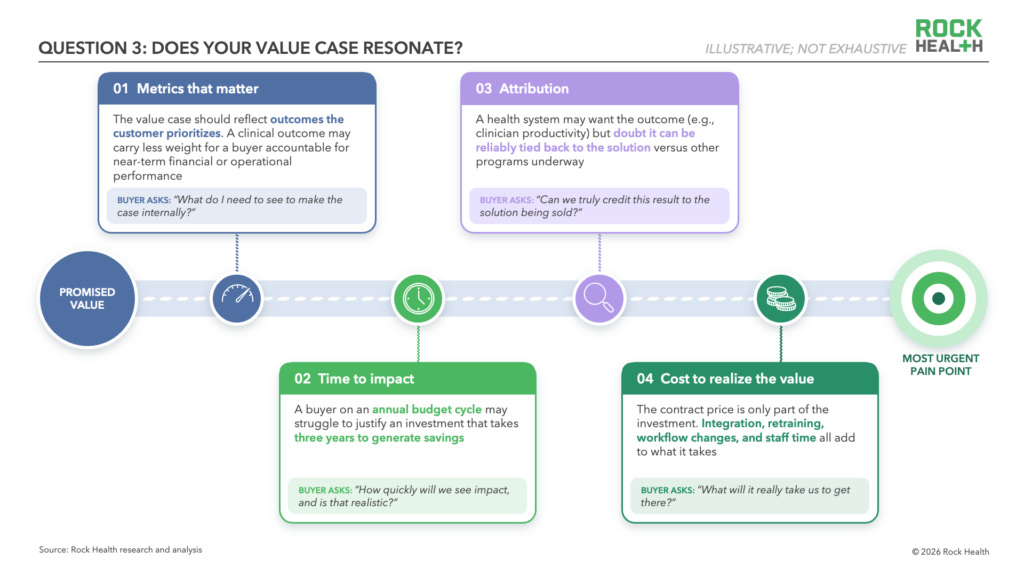
The value case drives the commercial conversation. What a customer is willing to pay, and on what terms, will depend in part on the impact they expect the solution to deliver. A value-based arrangement, for example, places even more weight on measurement and attribution, since payment depends on demonstrating an agreed-upon outcome. A fee-for-service model will drive high scrutiny on utilization and engagement, since volume usage can drive budget uncertainty. And flat-fee pricing models, while predictable from a buyer perspective, can put pressure on the solution provider to manage their margins. The evidence behind the value proposition therefore needs to support the commercial case as well.
Bringing it together with a viable business model
The decisions made across market, buyer, and value eventually have to add up to a viable business model. A promising market matters less if reaching customers is prohibitively expensive; a compelling value proposition can still struggle if the price customers will bear doesn’t support the cost of delivering the solution. Across our work with companies bringing new healthcare products and solutions to market, a handful of considerations have proven durable, particularly when translating a GTM strategy into a business model that can work in practice:
- Real-world use puts boundaries around the business and contracting model. For example, license or fee-for-service both assume regular, measurable use, but may lack clarity on ROI and value
- Enterprise healthcare requires a model that works for both buyer and end user. Some models (e.g., data monetization, SaaS, prescription reimbursement)—involve a different buyer than the one who uses the product day to day. The customer footing the bill may have different priorities than the person using the product. A viable model has to work for both, and may require infrastructure to support each side of that relationship, from enterprise reporting requirements to an experience that keeps end users engaged
- Evidence can open up commercial options. The stronger a company’s ability to measure and attribute outcomes, the more flexibility it may have in how it structures payment. Value-based (or at-risk) arrangements make that relationship particularly clear, since payment depends on demonstrating an agreed-upon result, but introduce other constraints such as attribution and time to impact
These principles don’t point to a single “right” model. Instead, they help test whether the GTM strategy and the business behind it can work together. And as the path to commercialization unfolds, the model will change. In the end, the frameworks and questions may be consistent, but the answers depend on the product, the organization, and the relevant market context. Teams that are designed to routinely pressure-test their assumptions against the conditions they expect to encounter enter the market with a more grounded commercial strategy—and a clearer view of what they need to do to succeed.
Whether you’re entering a new market, pressure-testing an existing GTM strategy, or figuring out how to turn a new growth opportunity into a commercial motion, Rock Health can help. Get in touch with us.
Stay plugged into the Rock Health community and all things digital health with the Rock Weekly.